
Guide, United States
Emergency radio buying guide: hand crank and NOAA weather
Last reviewed: November 1, 2026
A good emergency radio receives the NOAA weather band, runs without the wall socket, and does one or two extra jobs such as a light or a phone charge. Ready.gov puts a battery-powered or hand crank radio, and a NOAA Weather Radio with tone alert, on its basic supplies list. The radio is how you hear official warnings when the internet and the cell network are struggling.
These are products we sell, and this guide covers some of them. We print no prices because they change. We use only the figures printed on each listing, and we have not bench-tested any radio.
Why a radio
The National Weather Service says NOAA Weather Radio is a nationwide network of radio stations broadcasting continuous weather information. It says the broadcasts carry official Weather Service warnings, watches, forecasts and other hazard information, and it calls the service an "All Hazards" radio network. It also says that listening takes a special radio receiver or scanner capable of picking up the signal. An ordinary AM/FM radio will not do it.
Ready.gov's evacuation page adds a second reason: it says to listen to a battery-powered radio and follow local evacuation instructions, and to always follow the instructions of local officials. In a storm or a long outage, a radio that does not depend on the grid is the plain way to get those instructions.
What to look for
- The weather band. The National Weather Service lists seven frequencies for NOAA Weather Radio, from 162.400 to 162.550 MHz. Check that the radio's listed weather band covers them.
- Tone alert. Ready.gov's kit list says "NOAA Weather Radio with tone alert". Our listings say the radios receive weather alerts, and they do not state a tone alert feature by that name, so check the product page and the manual if that matters to you.
- More than one power source. A crank, solar panel, USB and batteries each fail differently. Count the ways a radio can be powered.
- The battery size, if you want phone charging. A larger battery number means more stored charge. Compare mAh figures on the listing, not the adjectives.
- A light. Many radios include a flashlight or lantern. It does not replace a headlamp, but it is the one you will find in the dark.
- Size and weight, if it has to go in a go bag.
- Practice. Crank it, tune it and find your local weather station before the storm.

Our emergency radios
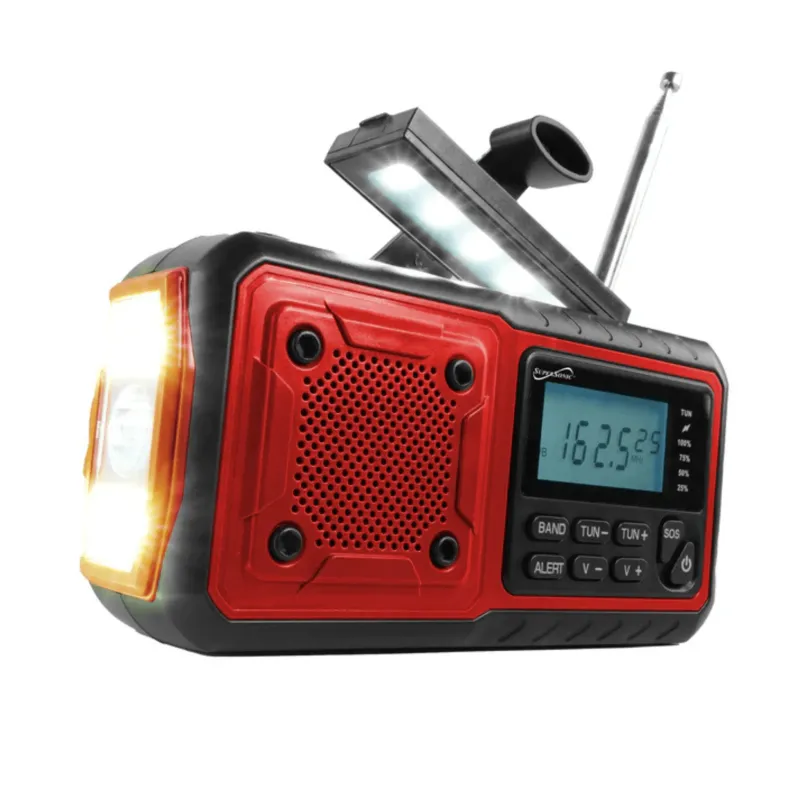 Guardian multi-powered emergency radioAM, FM and NOAA weather alerts, 4,000 mAh battery, crank, solar and USB-CSee details and price
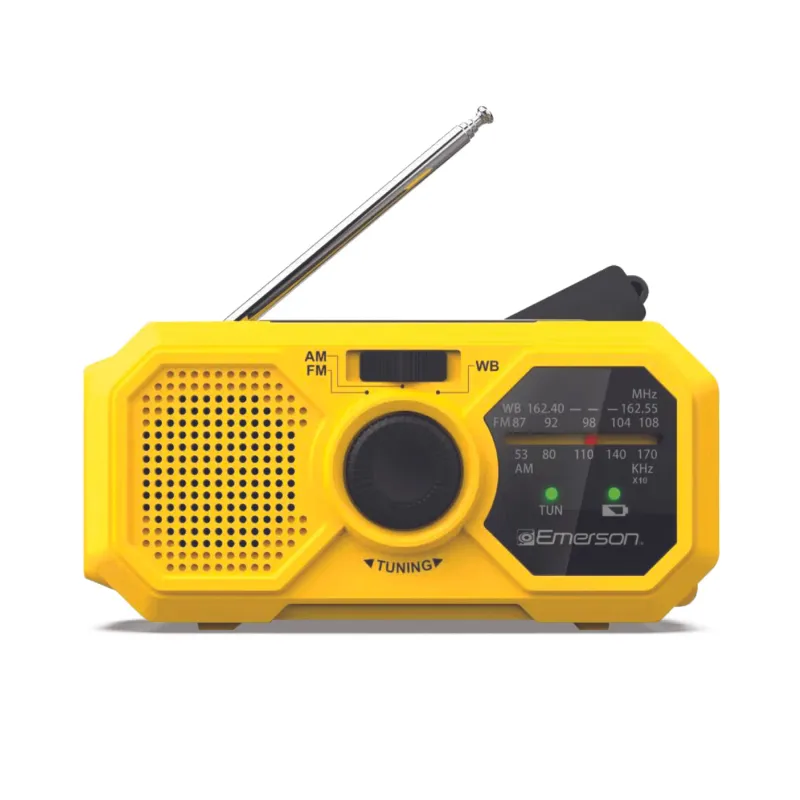 Emerson emergency AM/FM radio with weather bandAM, FM and the NOAA weather band, 1,200 mAh battery, crank, solar and USB-CSee details and price
- USB crank flashlight and radioListed as a USB crank flashlight and radioSee details and price
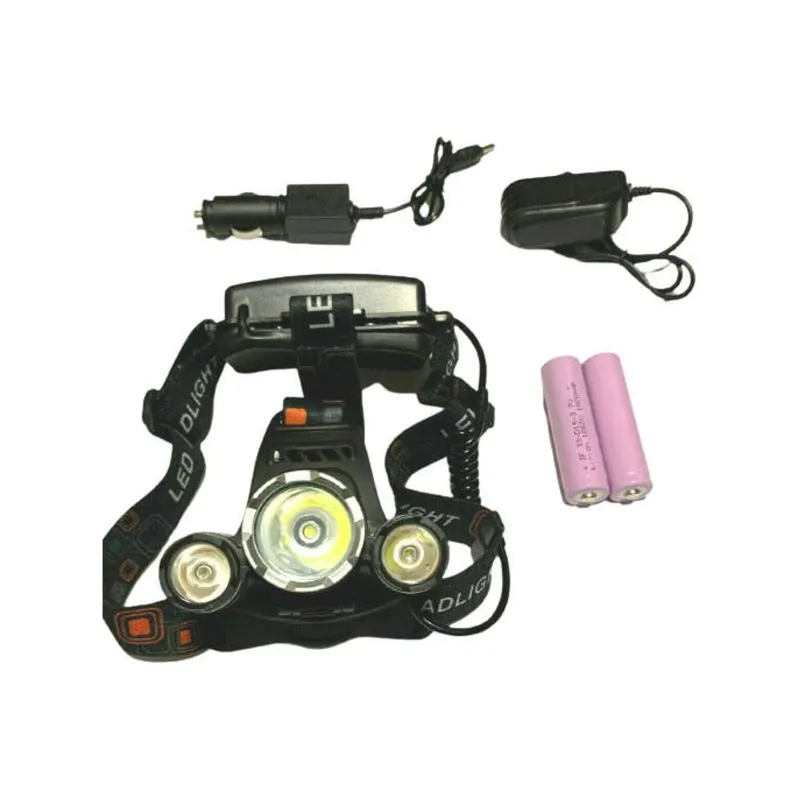 3 in 1 high powered LED headlampRechargeable, wall and car chargers in the boxSee details and price
Guardian multi-powered radio
The listing says the Supersonic Guardian receives AM, FM and NOAA weather alerts. It runs on a built-in 4,000 mAh rechargeable battery, a 1.5 W solar panel, the hand crank, USB-C or 3 AAA batteries, and the batteries are not included. It has a flashlight and a lantern, an SOS alarm with flashing light, a USB port to charge a phone, a digital LED display, a 3.5 mm headphone jack and a 360 degree telescopic antenna. In the box: the radio, a USB-C cable and a manual. Model SC-1078ERN, 6.02 x 1.85 x 3.03 in, 0.77 lb.
It suits a household that wants the biggest battery and the most power options in one small unit.
Emerson radio with weather band
The listing says this Emerson tunes AM, FM and the NOAA weather band, with the weather band listed at 162.4 to 162.55 MHz. That range lines up with the seven frequencies the National Weather Service gives. It charges three ways: the hand crank, the small solar panel or a USB-C cable. A built-in light with SOS mode and a USB-A output let it top up a phone from its 1,200 mAh battery. The listing gives AM 520 to 1710 kHz, FM 87 to 108 MHz, a 0.5 W speaker, a 0.25 W solar panel, and USB-C input and USB-A output at 5 V, 1 A. In the box: the radio, a hand strap and a USB charging cable. Model ER-7050.
It suits a household that wants a simple weather radio with a hand crank, and is happy with a smaller battery.
USB crank flashlight and radio
The listing names it a USB crank flashlight and radio and gives no further specification, so read the product page before you rely on any feature. We include it in our power outage pack and our 72 hour packs. We do not know its weather band or battery from the listing, so we do not say.
Headlamp, for the light
A radio's built-in light is a backup. The 3 in 1 rechargeable headlamp has three LED bulbs and three lighting functions, and charges from the wall or from the car, with both chargers in the box. It frees both hands in a blackout.
How the radios compare
| Guardian | Emerson | Crank flashlight and radio | |
|---|---|---|---|
| AM and FM | Yes | Yes | Check the page |
| NOAA weather | Yes, alerts | Yes, 162.4 to 162.55 MHz | Check the page |
| Built-in battery | 4,000 mAh | 1,200 mAh | Check the page |
| Hand crank | Yes | Yes | Yes |
| Solar | 1.5 W | 0.25 W | Check the page |
| Phone charging | USB port | USB-A out, 5 V, 1 A | Check the page |
| Light | Flashlight and lantern | Light with SOS mode | Flashlight |
Phone charging from a radio is an emergency top-up. The listings do not say how many full charges a phone will get, and we do not either.

Radio in your kit
Put the radio with the rest of the kit in one designated place, as Ready.gov advises. A radio kept in the kit is also a good place to store spare batteries. Ready.gov's winter weather page also asks you to keep extra batteries for radios and flashlights. Our power outage kit list shows where a radio fits, and our 72 hour kit list shows the same for a go bag. Our power outage pack and 72 hour packs already include a crank flashlight and radio.
Questions people ask
Do I need a NOAA radio if I have a phone? A phone is useful, and phones can lose power or signal. The National Weather Service describes Weather Radio as a separate broadcast network, and a radio receiving it does not depend on your cell network.
Which radio should I buy? If phone charging and a long run time matter most, compare the battery figures and take the Guardian. If you want a simpler weather radio, the Emerson lists its weather band in full. Check the product pages for current availability.
Does a hand crank really work? The listings say the radios charge by crank. We have not timed it and do not give a run time.
How often should I test it? Ready.gov asks you to re-think your needs and update your kit every year. Turn the radio on at that check.
Sources and last checked
All pages opened on November 1, 2026.
- National Weather Service: NOAA Weather Radio.
- Ready.gov: Build a Kit.
- Ready.gov: Evacuation.
- Ready.gov: Winter Weather.
The National Weather Service page links to receiver and SAME pages that we did not open, so nothing here is taken from them. Product specifications come from the product pages on this site. If you find an error, tell us through the contact page and we will check it against the source.


More guides for United States
- 72 Hour Kit vs Build Your Own: Which Should You Buy?
- 72-Hour Kit List for a Family, With Free Printable
- Affordable Home Security for Renters: Sensors, Locks, Lights
- Best Bug Out Bag: How to Choose a Pack and a Kit
- Best Emergency Food Supply for a Family: Buckets and Bundles
- Best First Aid Kit for Home and Car: How to Choose
- Bug Out Bag List for a Family of Four
- Home Security for Renters: No-Drill Options
- Power Outage Emergency Kit: Full List and Safety Rules
- Prepping for Beginners: A Calm 7-Day Plan
- Winter Storm Preparedness Kit: A Checklist for Home