
Guide, United States
72 hour kit vs build your own: which should you buy?
Last reviewed: November 1, 2026
Buy a ready-made 72 hour kit if you want the basics in one container this week and you will add water and personal items yourself. Build your own if you want every item chosen for your household and you will actually finish shopping. The most common failure with either route is the same: the kit is not finished, or not looked at again. Many households do both, buying a kit and then upgrading it.
These are products we sell, and this guide covers some of them, so weigh our view accordingly. We print no prices, because they change. The product pages show current prices and stated specifications.
What "72 hours" means
Ready.gov does not give a number of days. Its kit page says that after an emergency you may need to survive on your own for several days, and its food and water pages both say "several days". Three days is our own choice for a minimum pack size, and not an official rule. Whatever size you choose, the same two quantities decide it: people and days.
The case for building your own
- You choose each item, so the kit fits your household, your medicines, your pets and your dietary needs.
- You can use what you already own. A flashlight, a radio or a first aid kit already in the house does not need buying twice.
- You can spread the cost over several weeks.
- You learn what is in it. A kit you assembled is a kit you know.
The risks are time and gaps. Ready.gov's kit list runs from water, food, a radio, a flashlight and a first aid kit to a whistle, a dust mask, plastic sheeting, duct tape, moist towelettes, garbage bags and plastic ties, a wrench or pliers, a manual can opener and a local map. That is a lot of separate purchases, and a half-built kit tends to stay half-built. Our 72 hour kit list walks through the list item by item.
The case for a ready-made kit
- It exists on day one. You can have a kit in the closet before the next storm.
- It is one container, which is easier to store, grab and keep in a car.
- The basics are covered, including items many people forget.
The risks are fit and water. A ready-made kit is made for a generic household, so check the contents list against your own: medicines, infants, pets and dietary needs are yours to add. And water is where most ready-made kits fall short of Ready.gov's rate, so do the arithmetic.
The water arithmetic
Ready.gov says to store at least one gallon of water per person per day for several days, for drinking and sanitation. For three days that is 3 gallons per person, which is 6 gallons for two people and 12 gallons for four. Our ready-made kits carry water pouches of 4 oz, and a gallon is 128 oz. The family of four dry bag kit, for example, lists 48 pouches, which is 192 oz, or 1.5 gallons. It also lists 40 water purification tablets and 4 one liter hydration bags, which help only when you have water to treat. That is not a flaw of one kit; it is why we say to store water separately, whichever route you choose.

Our ready-made kits
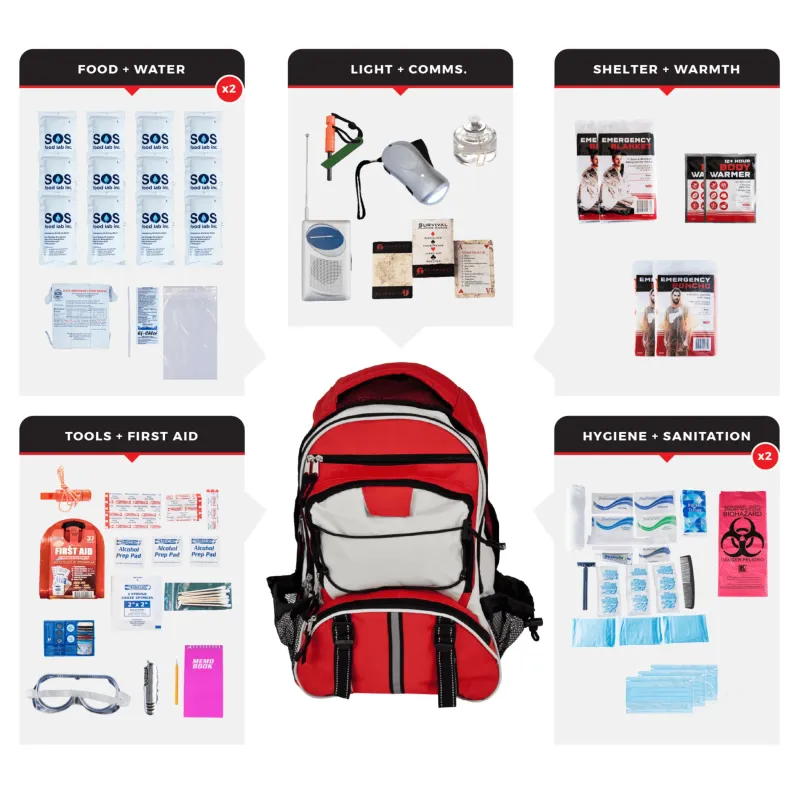 Essential survival kit for up to 2 people, with backpackA 72 hour kit for two in a backpackSee details and price
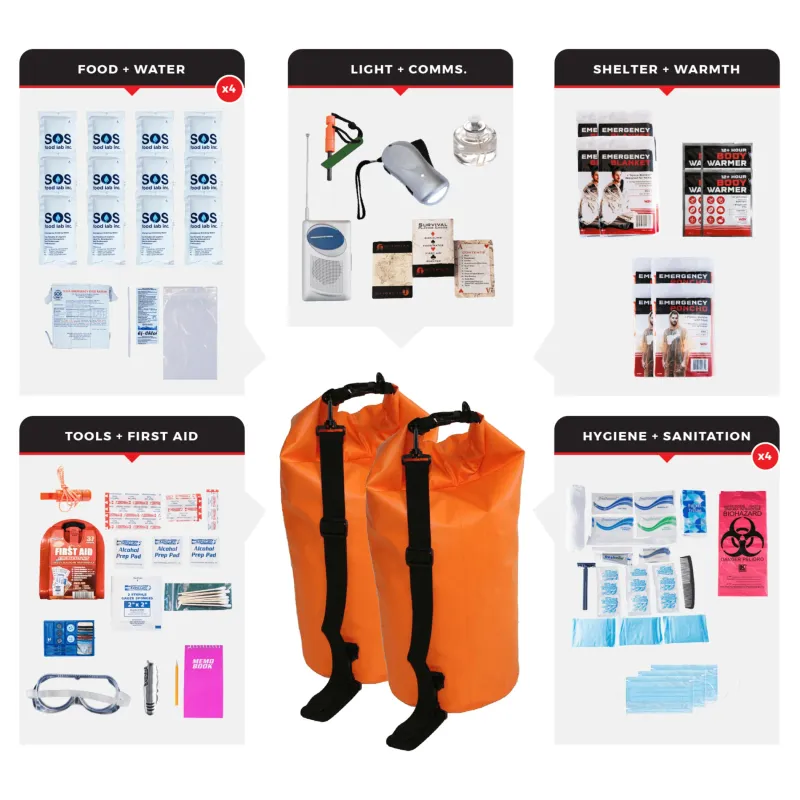 Essential survival kit for up to 4 people, with dry bagA 72 hour kit for a family of four in a dry bagSee details and price
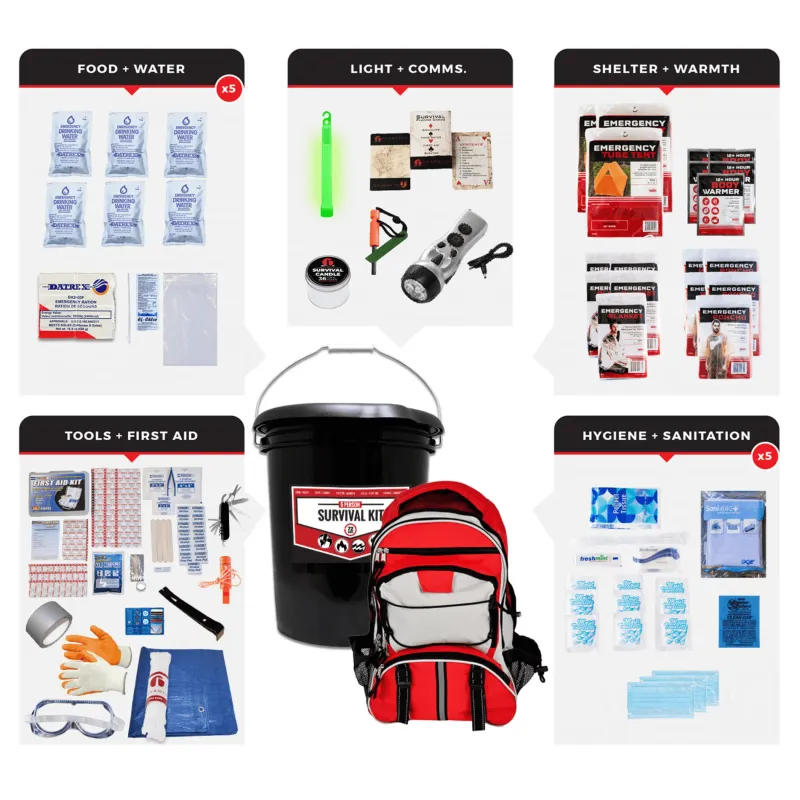 5 person 72 hour emergency survival bucket kitFive people, three days, in one 5 gallon bucketSee details and price
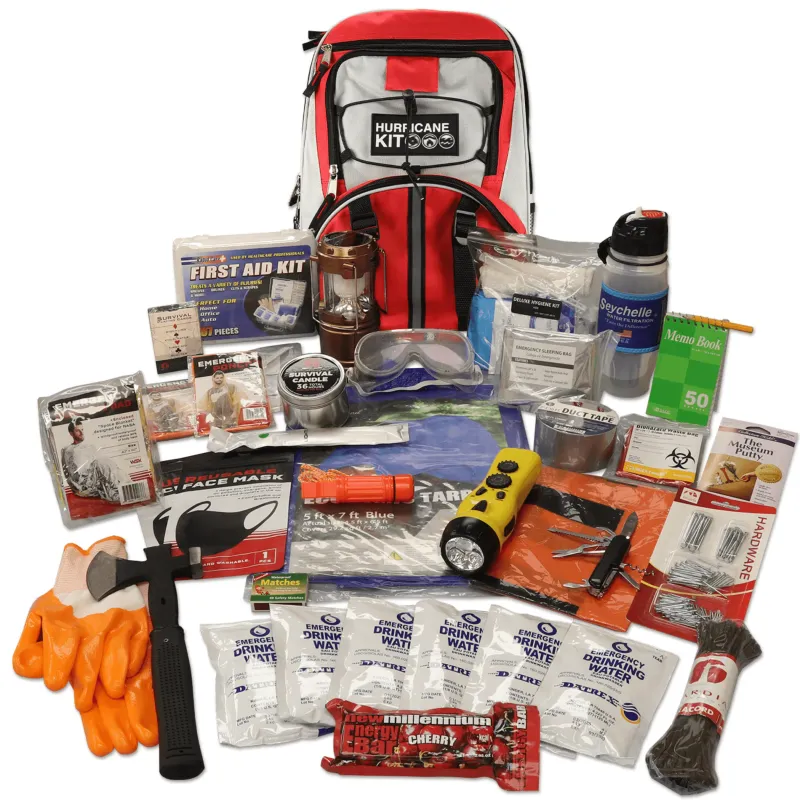 72 hour hurricane emergency survival kit with backpackStorm season kit in a red backpackSee details and price
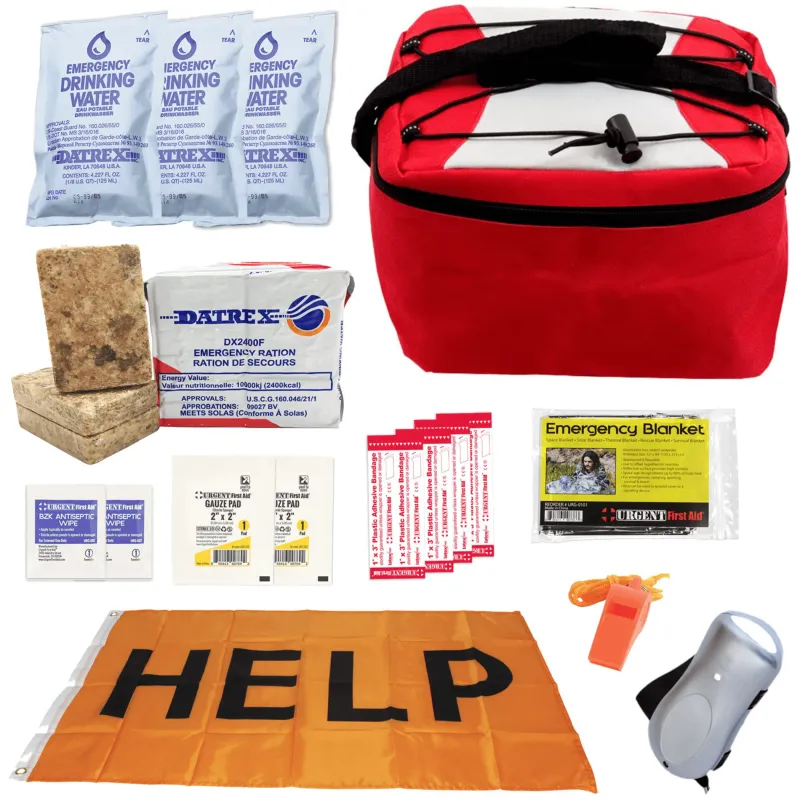 72 hour emergency commuter survival kitA small kit for the car, desk or lockerSee details and price
For two: the backpack kit
The listing says it holds 24 water pouches of 4 oz and 18 food bars of 400 calories, with a stated 5 year shelf life, 20 water purification tablets and 2 one liter hydration bags with straw. Also inside: a small bandage kit, whistle, pocket multi tool, safety goggles, sewing kit, an AM/FM radio with batteries, a hand rechargeable flashlight, a 30+ hour candle, a flint starter, 2 emergency blankets, 2 ponchos, 2 hand warmers, 2 deluxe hygiene kits, 6 face masks and 2 waste bags. Model SKX2-BBP, 18 x 10 x 10 in, 16 lb.
For four: the dry bag kit
The same contents scaled for four, per the listing: 48 water pouches, 36 food bars, 40 purification tablets, 4 hydration bags, 4 emergency blankets, 4 ponchos, 4 hand warmers, 4 deluxe hygiene kits, 12 face masks and 4 waste bags, with one radio, one flashlight and one bandage kit. Model SKX4-BDB, 17.5 x 11 x 9 in, 20 lb. Note that the radio, flashlight, candle and multi tool are single items, not four.
For five: the bucket
The listing says one 5 gallon bucket holds everything for five people for three days, including a deluxe first aid kit and three tube tents. See our emergency food supply guide for the full arithmetic on its water and food.
Storm season and the car
The hurricane kit is a red multi pocket backpack with food and water for one day, lighting, shelter items, tools and a deluxe first aid kit, 14 lb. The commuter kit is a small package of 4 lb for a car, a desk or a locker. These are add-ons to a home kit, and not substitutes.
Our packs, built from separate items
Our packs are different: they are assembled from separate products in our catalogue, so each part has its own page.
- 72 hour kit for 2A 2 person survival kit with dry bag, two water filter straws, a crank flashlight and radio, two food bars and two foil blanketsSee details and price
- 72 hour kit for 4A 4 person survival kit with backpack, four water filter straws, a crank flashlight and radio, a 25 person first aid kit, four food bars and four foil blanketsSee details and price
The listings say the pack for two is built to cover three days for two people, and the pack for four three days for four people. They include water filter straws but not stored water, which is a point to remember: a straw filters water you find, and does not create it. Our packs follow our three day choice.
Side by side
| Ready-made kit | Pack of separate items | Build your own | |
|---|---|---|---|
| Time to a first kit | Fastest | Fast | Slowest |
| Fit to your household | Generic | Generic | Exact |
| Water included | Pouches, below the Ready.gov rate | Filter straws, no stored water | Whatever you buy |
| Risk | Unchecked contents | Unchecked contents | A kit that never gets finished |

A middle route
Most households end up here. Buy a ready-made kit or pack so you have the basics now. Then, over a few weeks:
- Add stored water to the Ready.gov rate.
- Add your own medicines, documents and the things only your family needs.
- Swap in items you prefer, such as a better flashlight.
- Put a smaller kit in each car.
- Re-think the kit every year, as Ready.gov asks, and note the date.
Questions people ask
Is 72 hours enough? Ready.gov says several days, so treat three days as a minimum and not a promise. For a longer outage, add more.
Which size for a family of four? The kit for four lists enough items for four people for three days, except water, which you add. Check the pages for current specifications.
Can I use a kit I buy and never open? Open it once. Read the contents, check dates and learn where things are.
Sources and last checked
All pages opened on November 1, 2026.
Product specifications come from the product pages on this site. If you find an error, tell us through the contact page and we will check it against the source.


More guides for United States
- 72-Hour Kit List for a Family, With Free Printable
- Affordable Home Security for Renters: Sensors, Locks, Lights
- Best Bug Out Bag: How to Choose a Pack and a Kit
- Best Emergency Food Supply for a Family: Buckets and Bundles
- Best First Aid Kit for Home and Car: How to Choose
- Bug Out Bag List for a Family of Four
- Emergency Radio Buying Guide: Hand Crank and NOAA Weather
- Home Security for Renters: No-Drill Options
- Power Outage Emergency Kit: Full List and Safety Rules
- Prepping for Beginners: A Calm 7-Day Plan
- Winter Storm Preparedness Kit: A Checklist for Home