
Guide, United States
Best emergency food supply for a family: buckets and bundles compared
Last reviewed: November 1, 2026
The best emergency food supply for a family is one that needs no cooking or refrigeration, that your household will actually eat, and that you can count: how many meals, for how many people, for how many days. A bucket kit is the simplest way to buy that in one box. A freeze-dried bundle gives more variety. Food bars are the lightest backup.
These are products we sell, and this guide covers some of them, so read the comparison with that in mind. We use only the specifications on each listing, we print no prices because they change, and we make no claim about taste, nutrition or how any food will keep in your conditions. The product pages show current prices.
What the official guidance asks for
Ready.gov's food page says to store at least a several-day supply of non-perishable food, to remember any special dietary needs, and to include a manual can opener and eating utensils. Its kit page says that after an emergency you may need to survive on your own for several days. It does not give a calorie figure or an exact number of days, and neither do we invent one.
So the practical criteria are these:
- Needs no chilling, heating or prep. If the power is out, food that must be refrigerated is the first thing you lose.
- Counted per person. Ready.gov asks for a supply, so work out people times days.
- Fits your dietary needs. Check the listing for what is in it, and do not assume.
- A stated shelf life, and a place to store it. Ready.gov advises keeping a kit in a designated place at home.
- Safe to eat when you open it. Ready.gov's food page says not to eat from cans that are swollen, dented or corroded, and its rule is "when in doubt, throw it out."
Water comes with the food
Food is half the job. Ready.gov's water page says to store at least one gallon of water per person per day for several days, for drinking and sanitation. For a family of four over three days that is 12 gallons. Our arithmetic, from that rate: five people over three days is 15 gallons.
Check how much water any all-in-one kit includes against that number. We do it below, because it is the figure that most often surprises buyers.

Our emergency food buckets and bundles
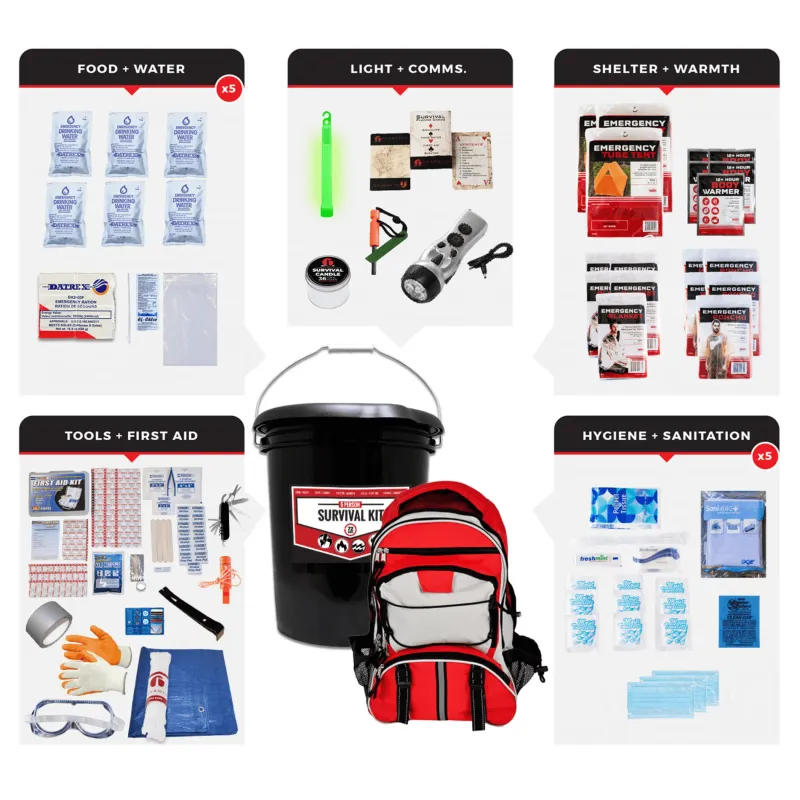 5 person 72 hour emergency survival bucket kitFood bars, water pouches, first aid kit, blankets and tools in one 5 gallon bucketSee details and price
- Alpineaire 72 hour emergency food bundleA 72 hour food bundle from AlpineaireSee details and price
- Alpineaire 1 week emergency food bundleThe one week version of the Alpineaire bundleSee details and price
- Emergency food bar, 3600 caloriesListed as an emergency food barSee details and price
- Emergency food bar, 2400 caloriesA smaller food bar, 2400 caloriesSee details and price
The 5 person 72 hour bucket
This is the all-in-one option. The listing says it holds everything for five people for three days in one durable 5 gallon bucket, 17 x 15 x 15 in and 26 lb. In it: 30 food bars of 400 calories and 30 water pouches of 4 oz, with a stated 5 year shelf life, plus 50 water purification tablets and 5 one liter hydration bags with straw. It also carries a deluxe first aid kit, 5 emergency blankets, 5 ponchos, 3 two person tube tents, 5 hand warmers, a dynamo flashlight, a 30+ hour candle, a light stick, a flint starter and 5 hygiene kits.
Here is the honest arithmetic. Thirty pouches of 4 oz is 120 oz, which is under one gallon in total. At Ready.gov's rate, five people for three days is 15 gallons. So the pouches are a starting point, not your water supply: the purification tablets and hydration bags only help if you have water to treat. Plan to store water separately. Thirty bars of 400 calories is 12,000 calories, which is 800 per person per day across five people and three days by our arithmetic. That is a fact about the box, and not advice on how much anyone needs.
What it suits: a household that wants one container for the closet or the car trunk, with the extras in the box. What it does not do: it does not give you a variety of meals, and it is not a long-term pantry.
The Alpineaire bundles
Alpineaire makes freeze-dried meals, and we sell a 72 hour bundle and a 1 week bundle. The listings name the bundles and say they ship from the United States, and they do not itemize the meals, so we will not describe what is inside. Open the product page and check the contents, the serving count and the stated shelf life before you decide. The bundles will need water and a way to heat it, which is where a stove and a water source come in (see below).
What they suit: a household that wants hot meals and more variety than bars, and has water and a stove.
Food bars
The 2400 and 3600 calorie bars are listed as emergency food bars, and the listings say little more. They do not break a bar into servings or state a shelf life, so check the product page before you count meals or plan to keep one in a car or a go bag.

How the options compare
| Option | Best for | Needs from you |
|---|---|---|
| 5 person bucket | One box, five people, three days | Extra water; storage space for a 26 lb bucket |
| Alpineaire 72 hour bundle | Hot meals, variety, three days | Water and a heat source; read contents on the page |
| Alpineaire 1 week bundle | A longer supply | The same, with more shelf space |
| Food bars | Car, go bag, backup | Water; check servings on the page |
What you will need besides the food
- A manual can opener and utensils. Ready.gov lists both.
- A way to heat water for freeze-dried food. Our portable gas stove is listed as a butane stove with automatic ignition, a gas leak prevention system and a pressure sensor with automatic shut off. Use any stove outdoors or with ventilation, and follow its manual.
- A way to make water safe. The gravity water filter with two carbon filters is listed for home, camping and RV use. See our emergency water guide for the rest of the water plan.
- A list of special dietary needs for every person in the house, including infants and pets. Check each listing; if a product does not state an ingredient, we cannot say it is absent.
How to choose, in order
- Count the days and the people. Ready.gov says several days; decide your number and write it down. Our own packs are built to 72 hours, which is our choice and not an official rule.
- Choose the format. One box (bucket), meals (bundle) or backup (bars). Many families buy a bucket for the closet and bars for the car.
- Add water first. Work from the one gallon per person per day rate before you add food.
- Check the listing for the stated shelf life and write the date on the container. Ready.gov does not give a shelf life for stored kits; the listing's figure is the supplier's own statement.
- Store it in one designated place and tell everyone in the house where it is, as Ready.gov advises for a kit.
- Re-think your needs every year. That is Ready.gov's maintenance line, and it is the right moment to check dates, swap what a child has outgrown and replace what you opened.
When food is not the problem
If the power fails, the first food decision is the fridge. Ready.gov's food page says to throw away any food that has been at room temperature for two hours or more. That is a reason to keep shelf-stable food in the kit and not to count on the freezer. Our power outage kit list goes through the rest of a blackout.

Questions people ask
Is a bucket enough for a family? It is a three day starting point for five people according to the listing. For a bigger family or a longer outage, add more food and a lot more water.
How long does the food last? Each listing states its own figure. The bucket's bars and pouches carry a stated 5 year shelf life, and that is the supplier's statement. Check the date on the packs you receive.
Which should a beginner buy? The bucket, because it is one decision. Then add water, then a stove if you want hot meals. Our 72 hour kit list shows the full picture.
Sources and last checked
All pages opened on November 1, 2026.
Product specifications come from the product pages on this site, which carry the supplier's stated figures. We have not tested any food. If you find an error, tell us through the contact page and we will check it against the source.

More guides for United States
- 72 Hour Kit vs Build Your Own: Which Should You Buy?
- 72-Hour Kit List for a Family, With Free Printable
- Affordable Home Security for Renters: Sensors, Locks, Lights
- Best Bug Out Bag: How to Choose a Pack and a Kit
- Best First Aid Kit for Home and Car: How to Choose
- Bug Out Bag List for a Family of Four
- Emergency Radio Buying Guide: Hand Crank and NOAA Weather
- Home Security for Renters: No-Drill Options
- Power Outage Emergency Kit: Full List and Safety Rules
- Prepping for Beginners: A Calm 7-Day Plan
- Winter Storm Preparedness Kit: A Checklist for Home